Icarus
The boy who flew too close to the sun

I’ve been thinking a lot about Icarus recently. I see a lot of interpretations of his tale on social media, many of them positive.
Icarus laughed as he fell, for he knew he had touched divinity.
What if Icarus had flown closer to the sea, and we were cautioned against playing it too safe?
We criticise Icarus, not because he dared, but because he failed.
All of these are valid in their own way, but it left me asking, Who is Icarus?
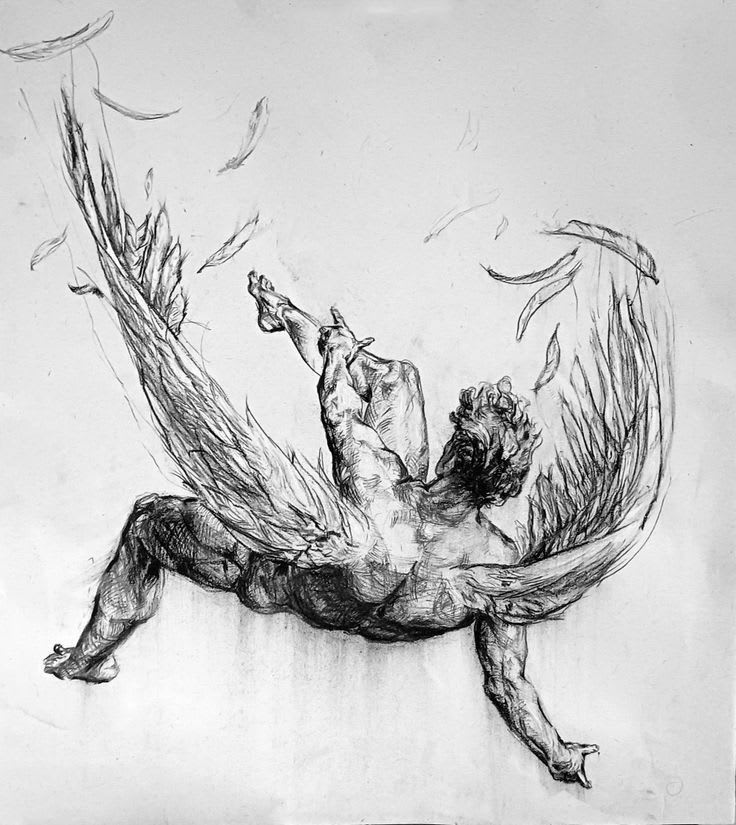
(Image credit: https://in.pinterest.com/pin/7388786884426815/)
Perhaps Icarus is gratification. He is hubris and the untamed fire of youth. He is our desire to leave our mark, to rival the gods, to leapfrog the very giants whose shoulders we stand upon.
He knew it was the first time human flight had even been attempted, let alone mastered by him. He had been warned by his father, and he was well acquainted with the capriciousness of the gods. Had he just waited, he could have flown to safety and then worked with his father to perfect the craft, perhaps finding safer alternatives or slowly testing the limits.
Yet the fire of youth is seldom satisfied with slow progress. Who is to say that he would have flown to safety? Who is to say that his father would have aided in such pursuits? Who is to say that even his wings would bear his weight again?
Perhaps he could have been wiser, or perhaps the moment was such that it would never come again.
Did Icarus laugh as he fell, or was he in despair? He knew he had failed, yet he knew the audacity of his task was second to none. He knew his father would be left to weep, yet he knew too that his own desires had been thoroughly fulfilled.
His was a conscious choice. Perhaps made with a heavy mind. Drunk on power, ambition, or recklessness. Perhaps made with a singular focus. An impulse, an all-consuming desire.
Or perhaps, it was made with full knowledge. Knowing the consequences, the risks and the rewards. Icarus’ choice may be judged any way you like, but his own agency, his right to choose remains undiminished.
Perhaps he laughed in despair, and cried in triumph. For the taste of victory, of ambition realized and passion seized is ever so sweet. Yet the bitter drought of failure, of death and mortality flames our senses no less. He had dared to chase his dream, and left a broken family behind.
One can only imagine how his father felt too, for his actions impacted the both of them, even if only life was claimed. Was it divine punishment? Condemned to live with the knowledge that he had given his own son the tools for his demise? Or was it a grim, dull pain?
Knowing that the choice was Icarus’ alone, yet his loss was no less painful because of it. The myth never speaks of him, neither shall we know if Icarus did, yet his pain demands no recognition for its existence.
Icarus fell so we would not.
Icarus fell, so mortals remembered their limits.
Icarus fell so we would not dare to fly.
Or
Icarus fell so we knew that flying was possible if one braved falling.
Icarus fell, for he refused to bow his head, and risk drowning in the seas.
Icarus fell, but he flew so high, none among the living who walked knew the world as he did.
Perhaps even, one might say
Icarus knew not how to balance ambition with caution. He fell from ambition, but did not drown in caution.
So Icarus knew victory, even in the hour of his greatest defeat, and Icarus learned humility at the very height of his triumph.
In the end, Icarus is human. Fearful to fly, yet choked by caution. Aiming for the sun, yet fearing the ire of the gods. Working hard till we burn out, or forsaking suffering and pain entirely in the name of protecting our peace.
Icarus made his choice, and he lived with it till the last. The question that remains, is whether we can live with the choices we make?

Icarus needed just a little more patience mastering the craft.
Oh Icarus! I used to jam to a good old rock song back in the 70's, featuring Icarus… Take a listen… 🎶 https://youtu.be/Kesio4k-dMU?si=ZSapBHqwaFVbxkFr